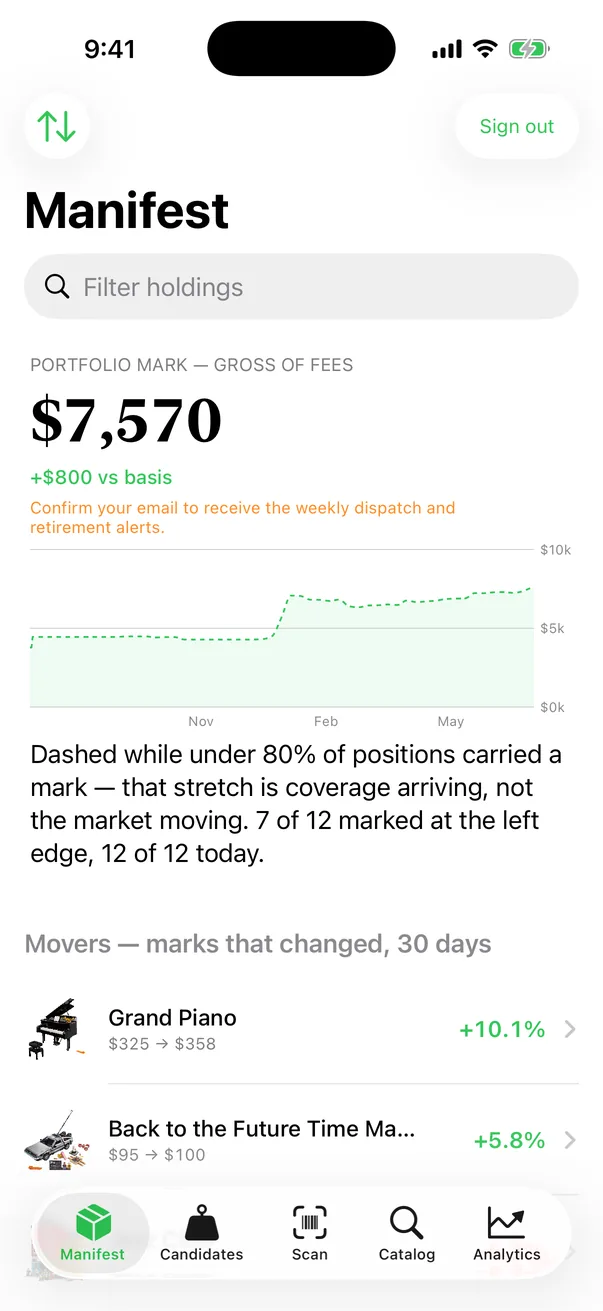
Not a guess, not an asking price. A mark taken from completed sales only — with the evidence printed on the face of every figure.
28,161 sets tracked. 9,891 carry a mark from real sold comparables, 3,764 of them on eight sales or more.
A 180-day window with a 42-day half-life, so last month’s sale counts for more than last spring’s. Under eight comps we call it thin — and say so.
Sealed and opened are priced separately. The gap between them is what an unbroken seal is fetching — the one number nobody else will give you.
Every figure on this page is a real number you can interrogate.
Start freeEvery number tells you how much to trust it.
Your sealed LEGO sets are a portfolio. Sealed marks them like one: brick-built sets priced from completed sales only, weighted by recency, net of the fees you'd actually pay, with the sample size printed on the face of every figure. A collector's tool, not a price guide: no wishful averages, no mystery numbers.
SEALED · TRAILING 180 DAYS ·
Type a LEGO set number. What comes back is the sealed set's mark from real completed sales, its middle range, how many sales stand behind it, and whether LEGO has retired it. It is the same figure a member's portfolio would carry.
A daily, append-only record of what sealed and used LEGO sets actually sold for, plus the minifigures and bricks inside them, reaching back to 2016 for the rarest and growing every night. Nobody can reconstruct it retroactively; that is why it is worth building.
Nobody outside LEGO knows a retirement date in advance, and Sealed does not pretend to. It runs three honest signals instead: a survival percentile from thousands of completed set lifespans, the regional cascade (a set that has already left the UK and German shops while still on US shelves), and the confirmed flip, logged the day the fact lands.
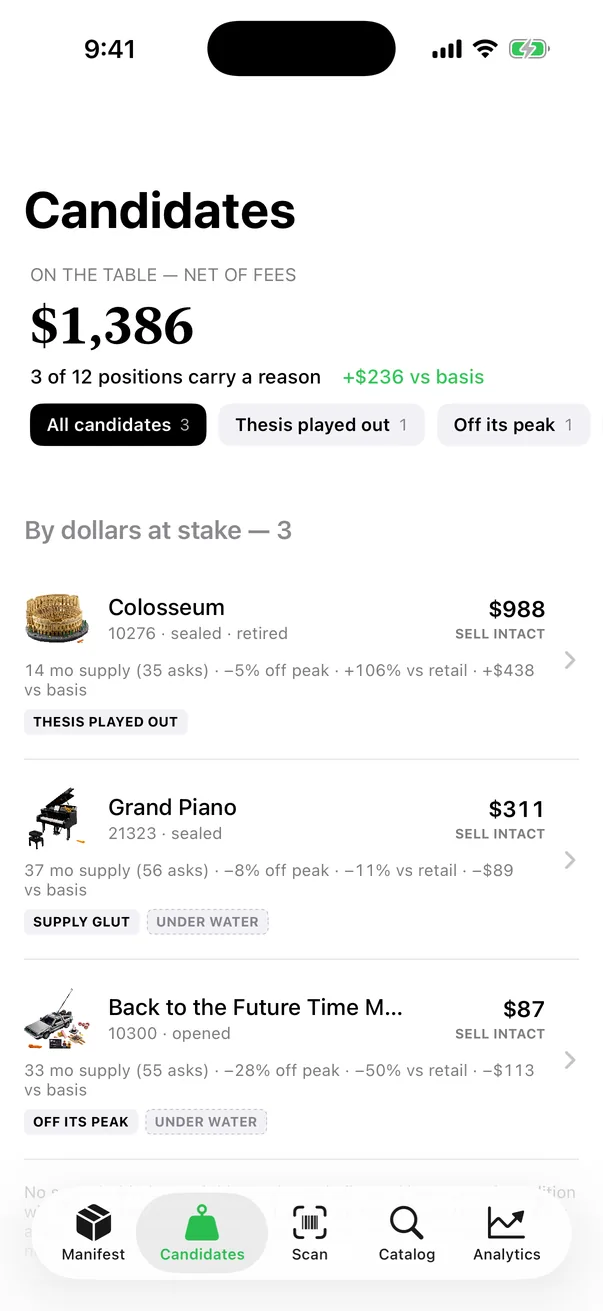
Candidates ranks the sets you hold by dollars at stake and flags each position with a named condition: retired and up, off its own peak, a supply glut, the market asking less. Three exits priced net of fees: the sealed box intact, parted out into bricks, or the minifigures alone. A score would be an opinion wearing a decimal point; a named reason can be checked.
Thresholds are calibrated to each book's own distribution; a shortlist that flags the median position is not a shortlist. Being under water is shown, but is context, not a reason to sell.
When a set retires, the market re-prices it within weeks. Sealed logs the flip, tells holders the same day, and the mark keeps tracking real sales, so the premium over retail is a measured fact, not folklore.
Retirement facts come from an official catalog API. Marks come from completed sales. Neither is a forecast.
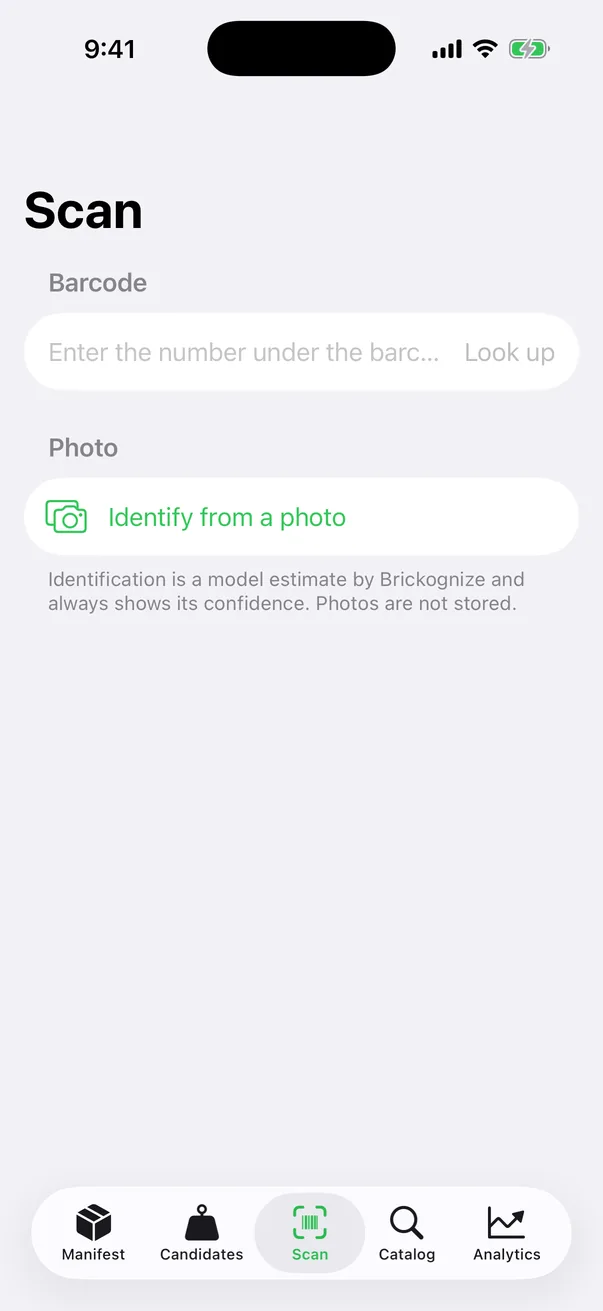
A native iOS app for the moment you are standing in a garage with a sealed LEGO box in your hands: scan the barcode, see the mark, add the lot. The rest of the archive rides along.
iOS · TestFlight opening to early-access members · Android not yet


Every mark carries its middle range and its sample count. Fewer than eight sales and it says thin to your face.
Asks are opinions. Marks come from completed sales only; the ask side is shown as what it is, the queue ahead of you.
A set with no qualifying sales is unmarked, not worthless. Missing evidence is missing evidence.
It measures survival odds and watches for the cascade, then reports the flip the day it is confirmed. Odds, evidence, fact, in that order.
The index is a fixed basket priced at both ends of the window. Value that appears because more sets got marked is labeled as exactly that.
A 2×4 LEGO brick belongs to a thousand sets. Barcodes are deterministic; photos show a confidence; piles stay unidentified.
Free while the archive grows. Import your LEGO collection from a BrickEconomy, Brickset, or eBay export, or scan a box; the archive prices your book from real sales the moment a set lands.